Motility-Induced Phase Separation
How self-propelled particles aggregate without attractive forces.
Summary
This project studies how active Brownian particles aggregate even when no attractive interaction is present.
Videos of my results in Motility Induced Phase Separation:
MIPS cluster formation YouTube
MIPS cluster merging YouTube
MIPS cluster dissolution YouTube
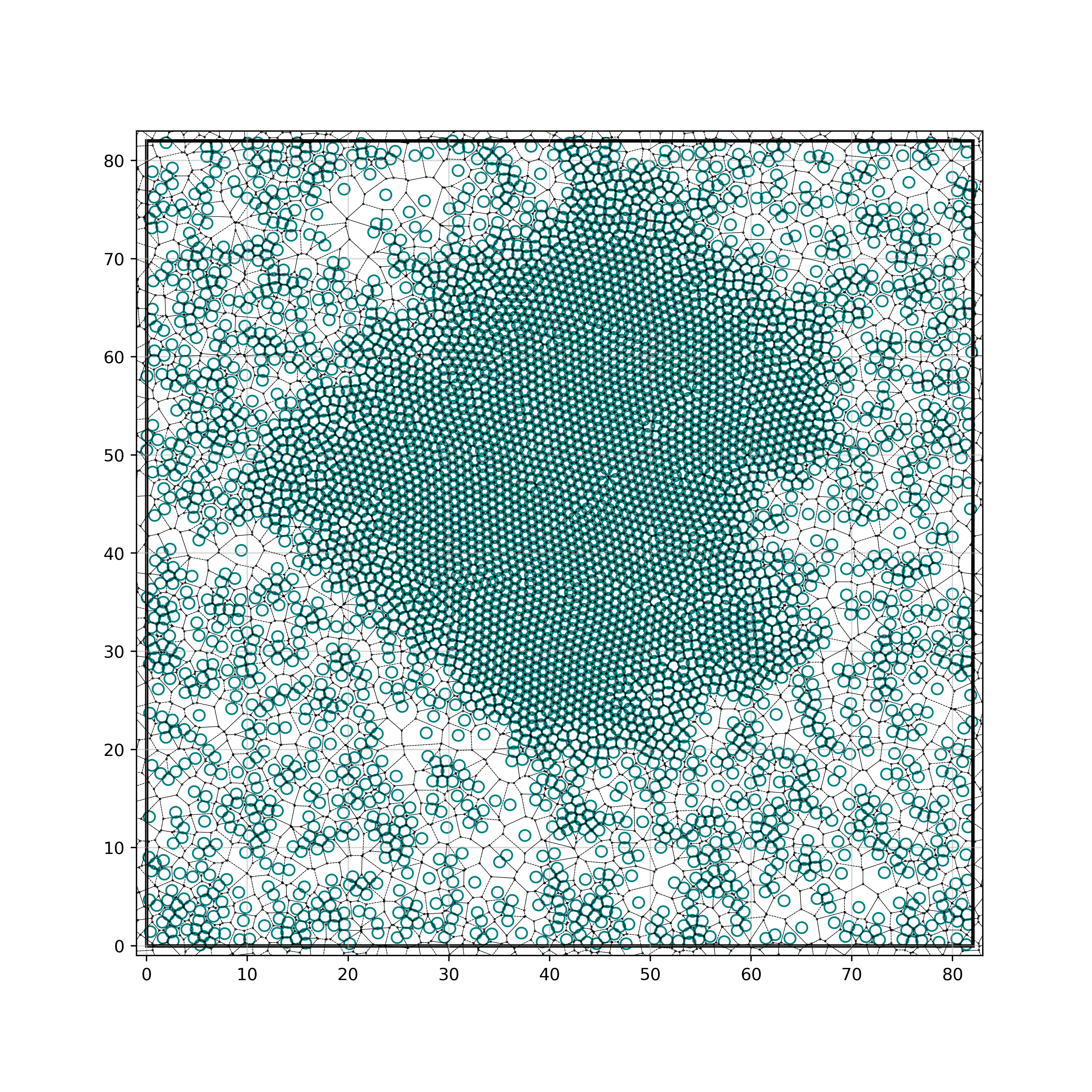
Voronoi tessellation of a MIPS cluster:
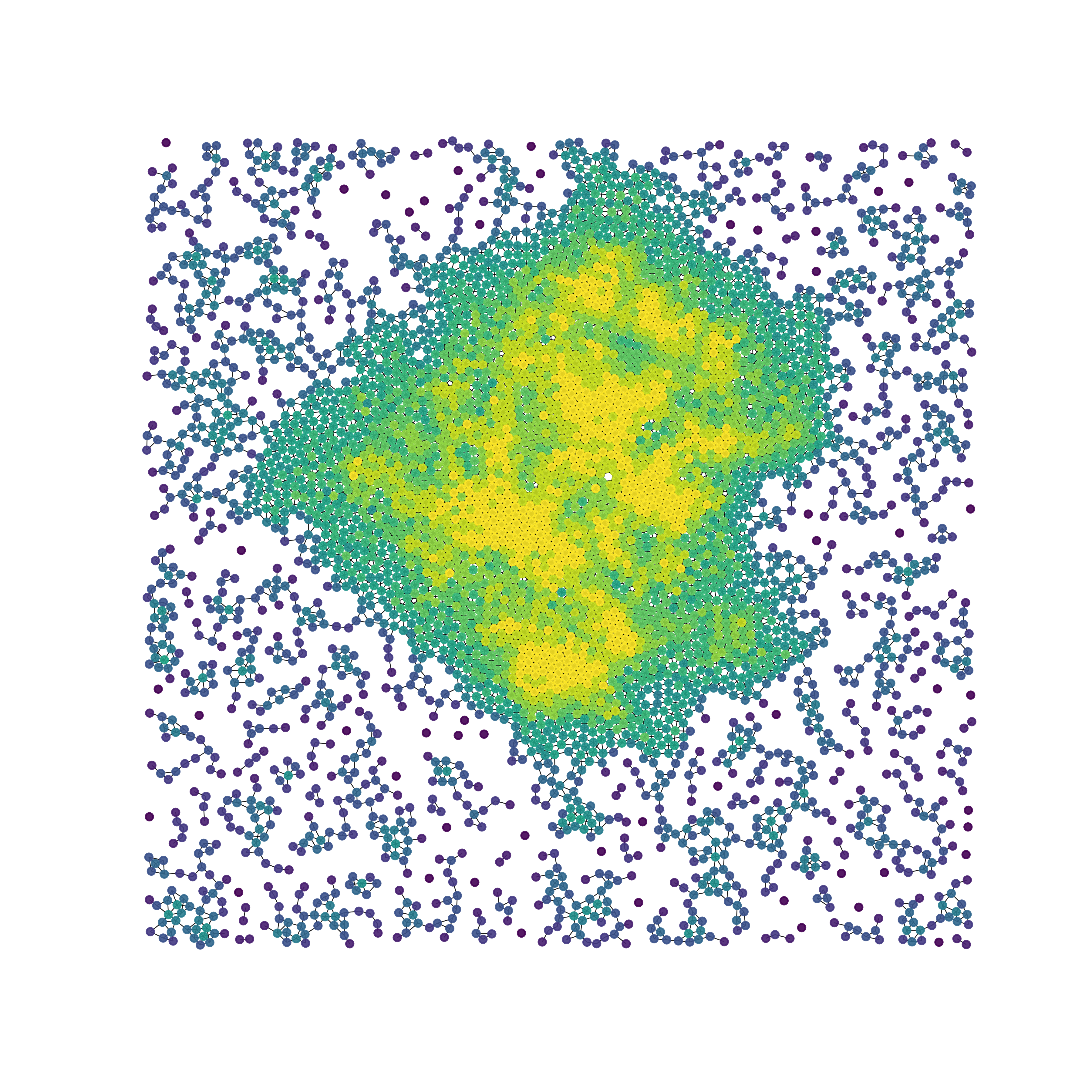
Adjacency graph of a MIPS cluster:
Introduction
From cytoskeletal filaments and bacterial colonies to bird flocks and fish schools, many biological systems consume energy from their surroundings to sustain organized motion. That continual energy input allows them to maintain non-equilibrium steady states rather than relaxing immediately toward equilibrium.
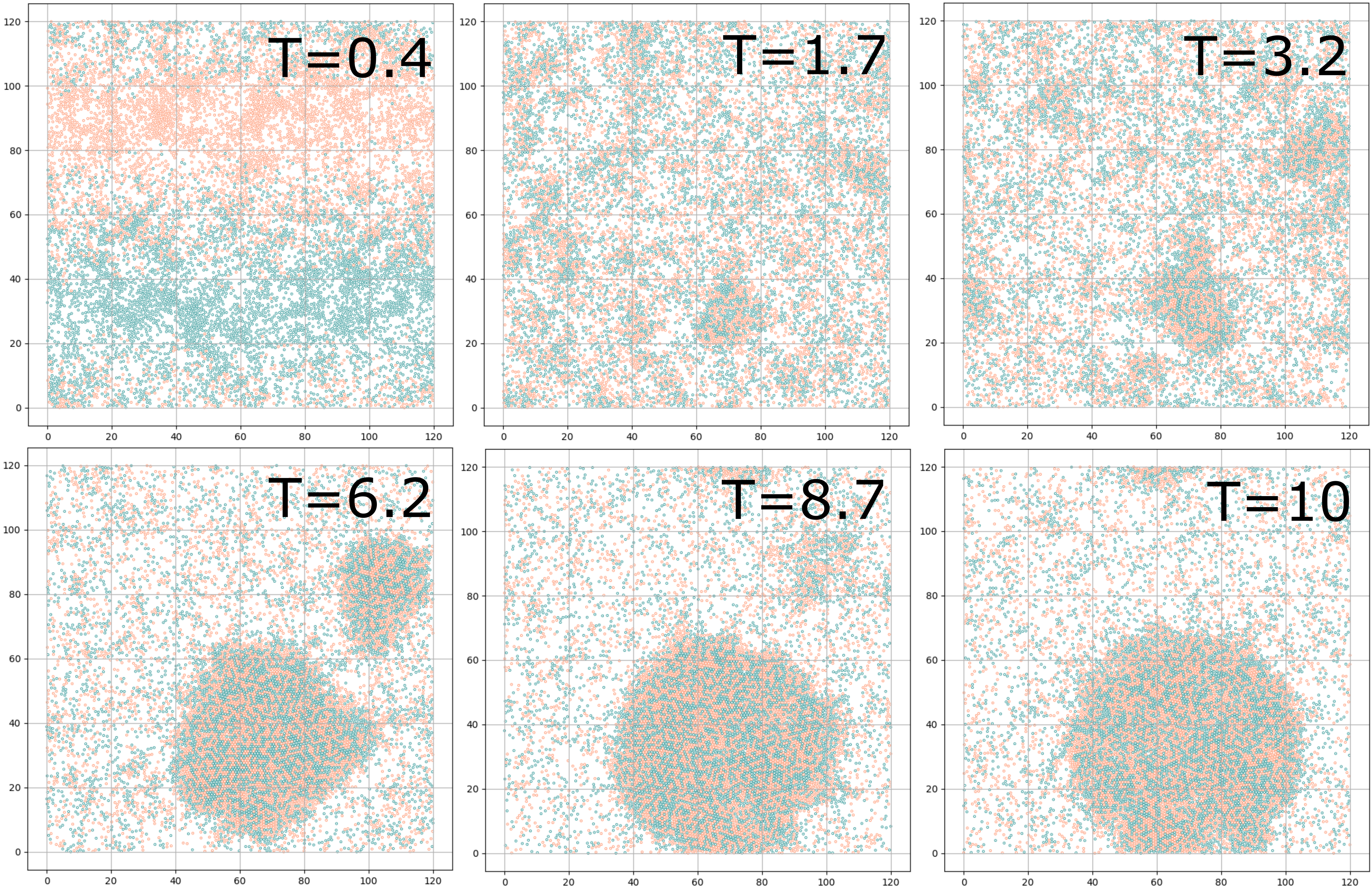
One of the minimal models to study active matter is the active Brownian particles model (ABP model). In the ABP model, particles are colloidal spheres. Particles are governed by Langevin’s equation that particles can self-propel themselves by absorbing and converting energy from the environment. This is one of the simplest forms of activity; nevertheless, even this minimal ingredient is enough to produce rich non-equilibrium behavior. Particles can aggregate into clusters without any attractive mechanism, a phenomenon known as motility-induced phase separation (MIPS).
Dynamics
The overdamped Langevin dynamics are given by
$$ \left\{\begin{split} \boldsymbol{\dot r_i} &= \frac{1}{\gamma }\boldsymbol{F_i} + {v_p}\boldsymbol{\hat n_i} + \sqrt {2D} {\eta _i}\\ {\dot \theta }_i &= \sqrt {2{D_R}} {\xi _i} \end{split}\right. $$
Here, $F_i=-{\nabla _r}\sum_j {V_j}\left( r_i \right)$ is the total force acting on particle $i$. $\vec{\hat n}$ is its self-propulsion direction, $D$ is the translational diffusion constant, and $D_R$ is the rotational diffusion constant. The random variables $\xi, \eta \sim \mathcal{N}(0,1)$ represent independent Gaussian white noise terms.
The potential is
$$ V(r)=4\varepsilon\left[\left(\frac{\sigma}{r}\right)^{12}-\left(\frac{\sigma}{r}\right)^6+\frac{1}{4}\right] \Theta\left(\sigma_*-|r|\right) $$
The underdamped dynamics are given by
$$ \left\{\begin{aligned} \boldsymbol{\ddot r_i} &=-\gamma_T \boldsymbol{\dot{r}_i} +\boldsymbol{F_i} +\gamma_T v_p \boldsymbol{\hat{n}_i} +\sqrt{2 D_T} \gamma_T \eta_i \\ \ddot{\theta}_i &=-\gamma_R \dot{\theta}_i+\sqrt{2 D_R} \gamma_R \xi_i \end{aligned}\right. $$
Voronoi Tessellation
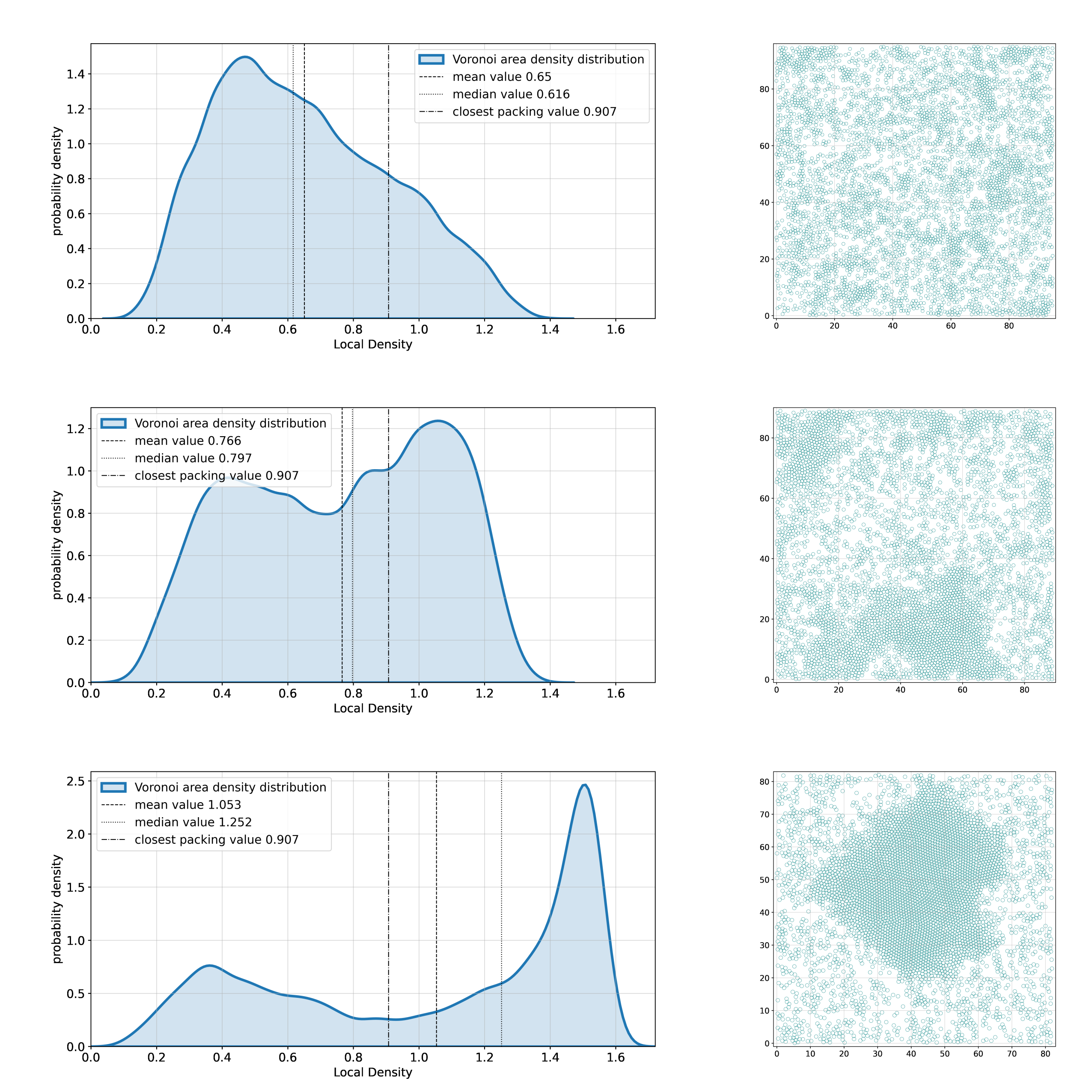
The local density in the system can be studied by the Voronoi Tessellation