Invariant Measures in Random Dynamical Systems
How random dynamics can generate fractal invariant measures.
Summary
This project studies how a simple random dynamical system can produce a fractal invariant measure. The simulation selects actions from a family of maps and visualizes the long-run distribution generated by repeated random composition.
Why Invariant Measures Matter
An invariant measure describes the statistical state that remains unchanged under the dynamics. In random systems, the individual trajectory may look irregular, but the distribution of many trajectories can converge toward a stable geometric pattern. That makes invariant measures a useful bridge between stochastic rules and visible structure.
Example
Consider a simple random dynamical system on a torus:
$$ {x_{n + 1}} = \left\{ \begin{array}{l} {f_0}({x_n}) = 4{x_n}\bmod \,1\\ {f_i}({x_n}) = \frac{x_n + i - 1}{16} \end{array} \right. $$
The index $i$ ranges from $1$ to $16$. At each step, the expansive map $f_0$ is chosen with probability $1/2$, while each contracting map $f_i$ is chosen with probability $1/32$.
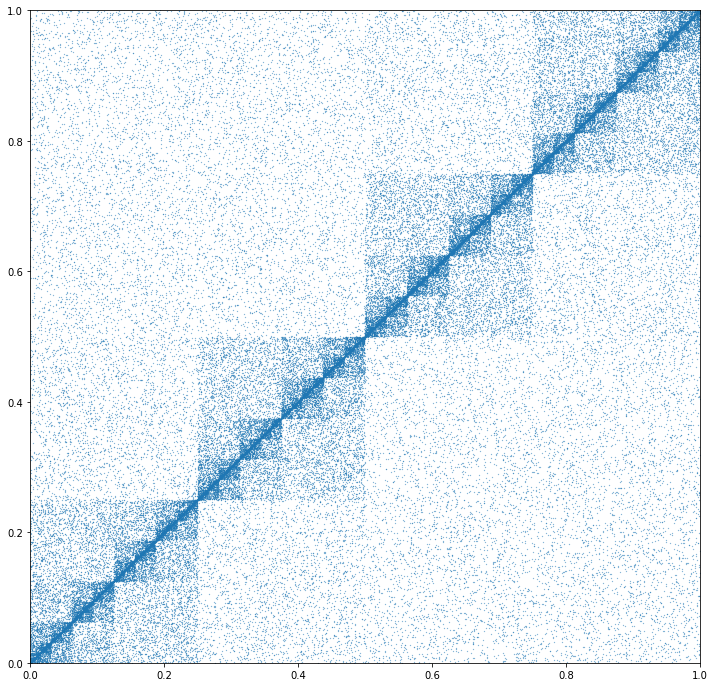
For a symbolic sequence \(\omega = a_0a_1a_2...a_N\) with \(a_i=0,...,16\), define \(f_{\omega} = f_{a_N} \circ ... \circ f_{a_0}\). Starting from samples drawn uniformly on the square, the simulation tracks the distribution of \((f_{\omega}(x),f_{\omega}(y))\) over repeated random compositions.
Display
Takeaway
The example shows how randomness and contraction can cooperate rather than cancel one another: repeated stochastic choices produce a stable distribution whose support has a visible fractal geometry.