Golden Ratio and Vortices
How vortex dynamics reveal bifurcations at golden-ratio thresholds.
Summary
Preview Version Published Version
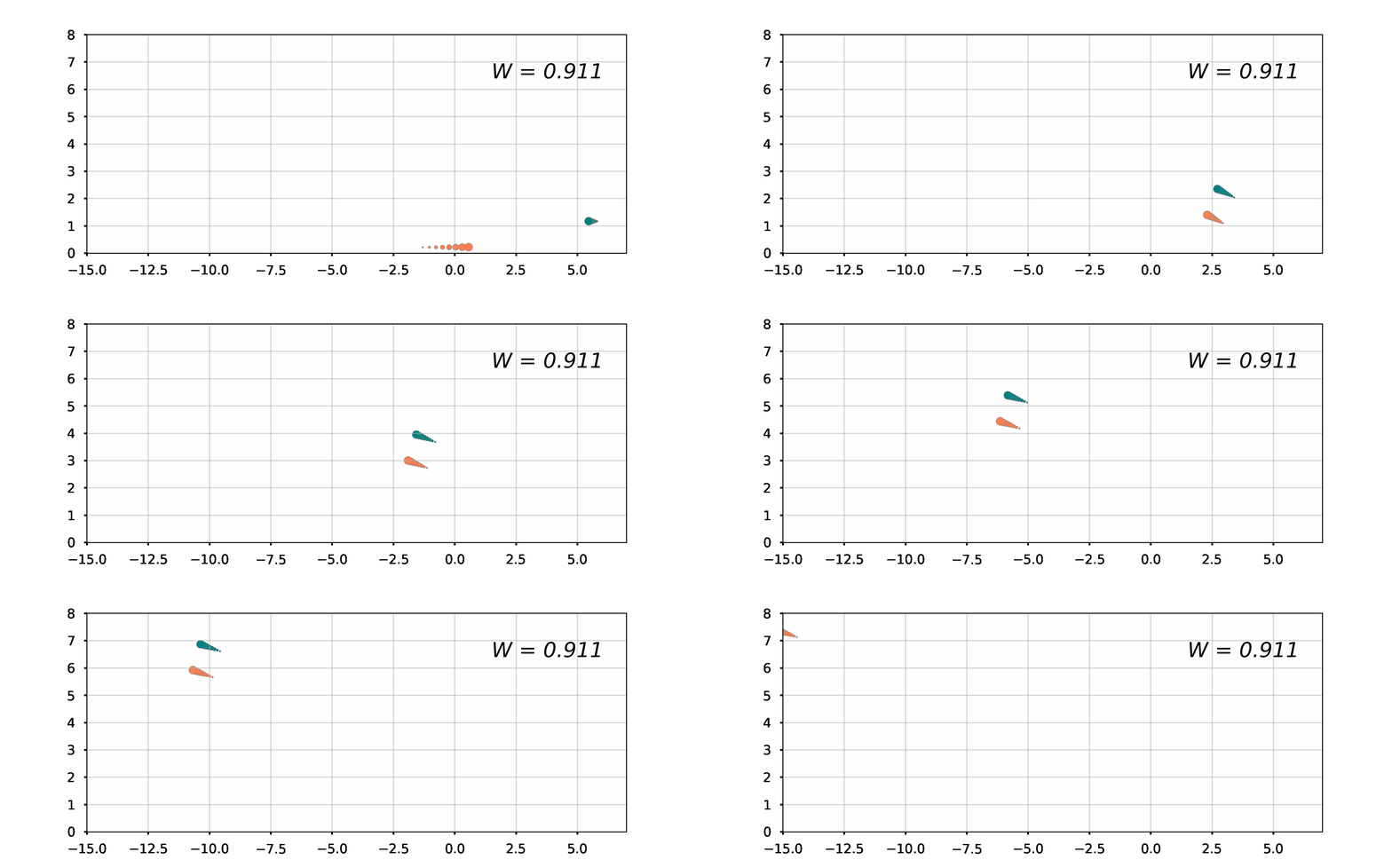
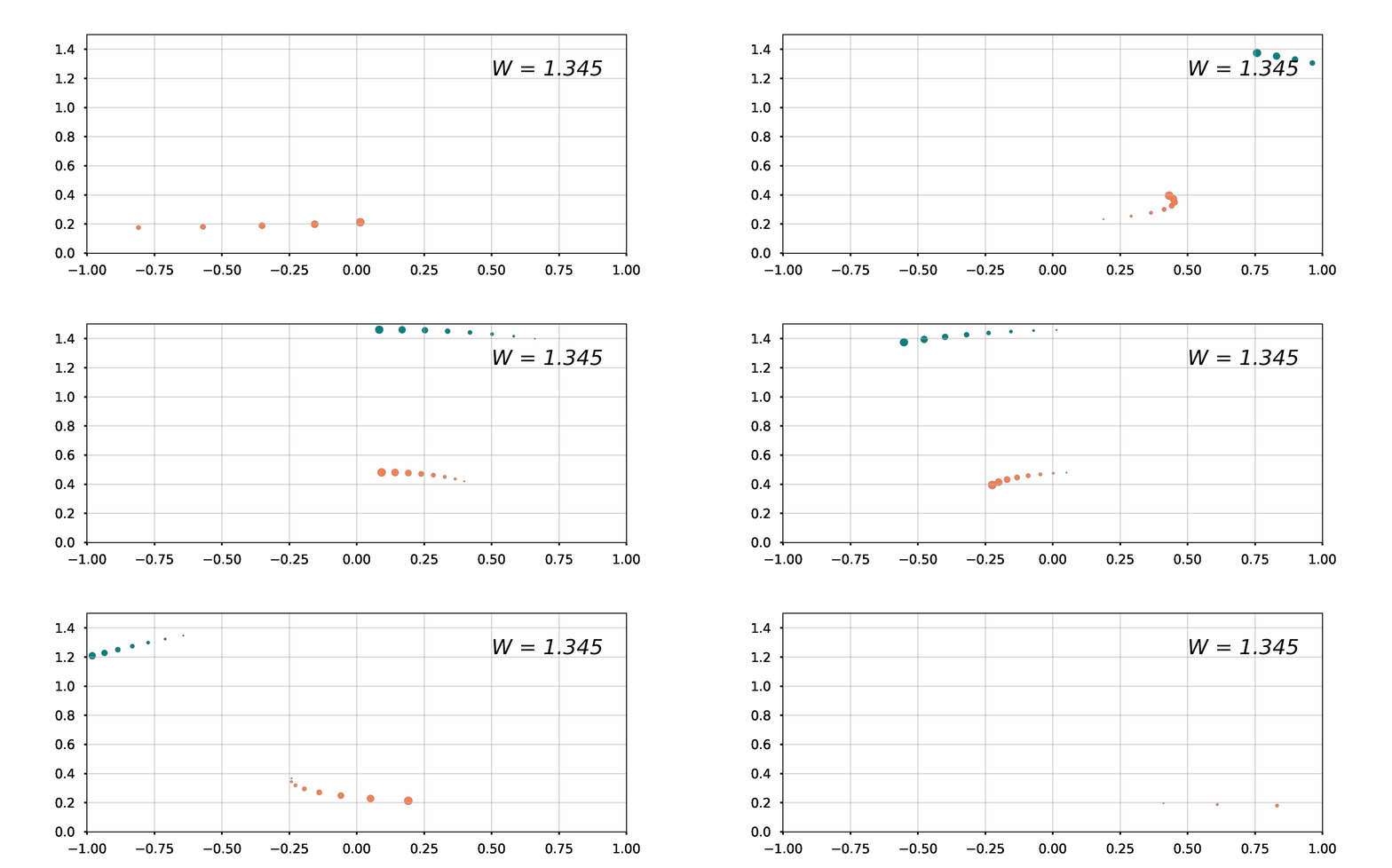
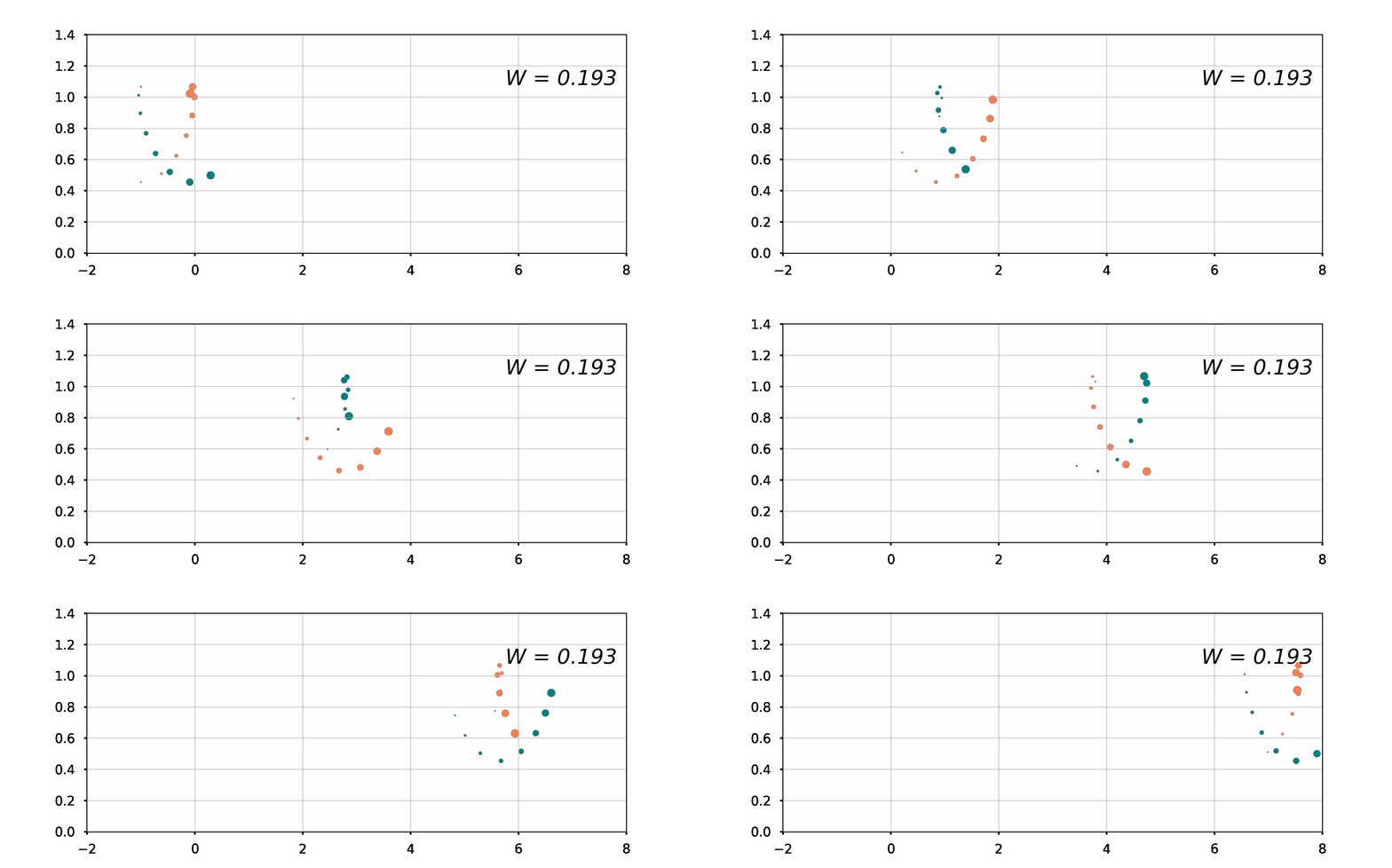
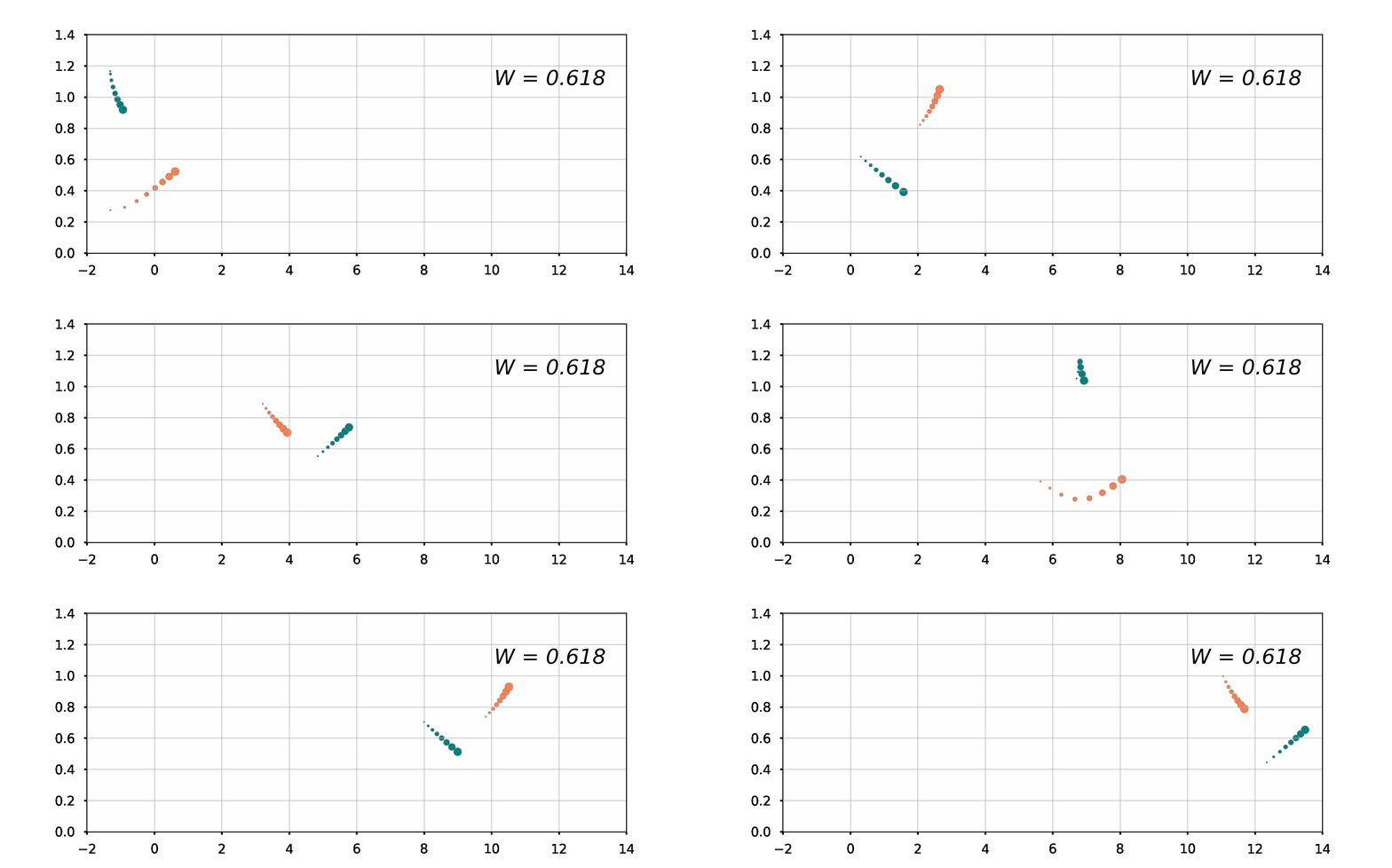
In this two-point-vortex system on the half-plane, \(W\) is a dimensionless parameter, and \(W=\phi, 1, \frac{1}{\phi}\) are three bifurcation values, where \(\phi\) is the golden ratio.
Two mechanisms act on each point vortex:
- translation along the boundary of the half-plane;
- rotation around the other vortex.
These two mechanisms compete and lead to different types of the trajectories.
Vortex Pair

Vortex Dipole

Introduction
A single point vortex on the half-plane can be represented by a vortex dipole symmetric about the boundary \((y=0)\) in the full plane. Thus, an \(N\)-point-vortex system in the half-plane is equivalent to a \(2N\)-point-vortex system in the full plane consisting of the original vortices and their images.
The Green’s function on the half-plane \(\mathbb{R}_+^2\) is
\[G_{\mathbb{R}^2_+}\left( {z,z'} \right) = - \frac{1}{2\pi}\log ||z - z'||+\frac{1}{2\pi}\log ||z - z'^*||\]and the Hamiltonian is
\[H=\frac{1}{4 \pi} \log \left(\left(2 y_1\right)^{\Gamma_1^2}\left(2 y_2\right)^{\Gamma_2^2}\left(\frac{\left(x_1-x_2\right)^2+\left(y_1+y_2\right)^2}{\left(x_1-x_2\right)^2+\left(y_1-y_2\right)^2}\right)^{\Gamma_1 \Gamma_2}\right)\]The first term represents the interaction between different vortices with their images; and the second term represents the interaction between a vortex and its image.
For the two-point-vortex system on the half-plane, the equations of motion are
\[\dot{x}_1=\frac{\Gamma_1}{4 \pi} \frac{1}{y_1}+\frac{\Gamma_2}{4 \pi}\left(\frac{2\left(y_1+y_2\right)}{\left(x_1-x_2\right)^2+\left(y_1+y_2\right)^2}-\frac{2\left(y_1-y_2\right)}{\left(x_1-x_2\right)^2+\left(y_1-y_2\right)^2}\right)\]and
\[\dot{y}_1=\frac{-\Gamma_2}{4 \pi}\left(\frac{2\left(x_1-x_2\right)}{\left(x_1-x_2\right)^2+\left(y_1+y_2\right)^2}-\frac{2\left(x_1-x_2\right)}{\left(x_1-x_2\right)^2+\left(y_1-y_2\right)^2}\right)\]To study vortex bifurcations we normalize their strengths by setting \(\Gamma_1=\Gamma_2=1\) for a vortex pair and \(\Gamma_1=-\Gamma_2=1\) for a dipole. Furthermore, introduce the following dimensionless parameter
\[W:=(P / \Gamma)^2 \exp \left(-4 \pi \mathcal{H} / \Gamma^2\right)\]measuring the vortex interaction where \(\Gamma:=\Gamma_1=\pm \Gamma_2\). As we will see below, the increase of \(W\) corresponds to the weakening of the interaction between the point vortices.
More GIF
Vortex Pair
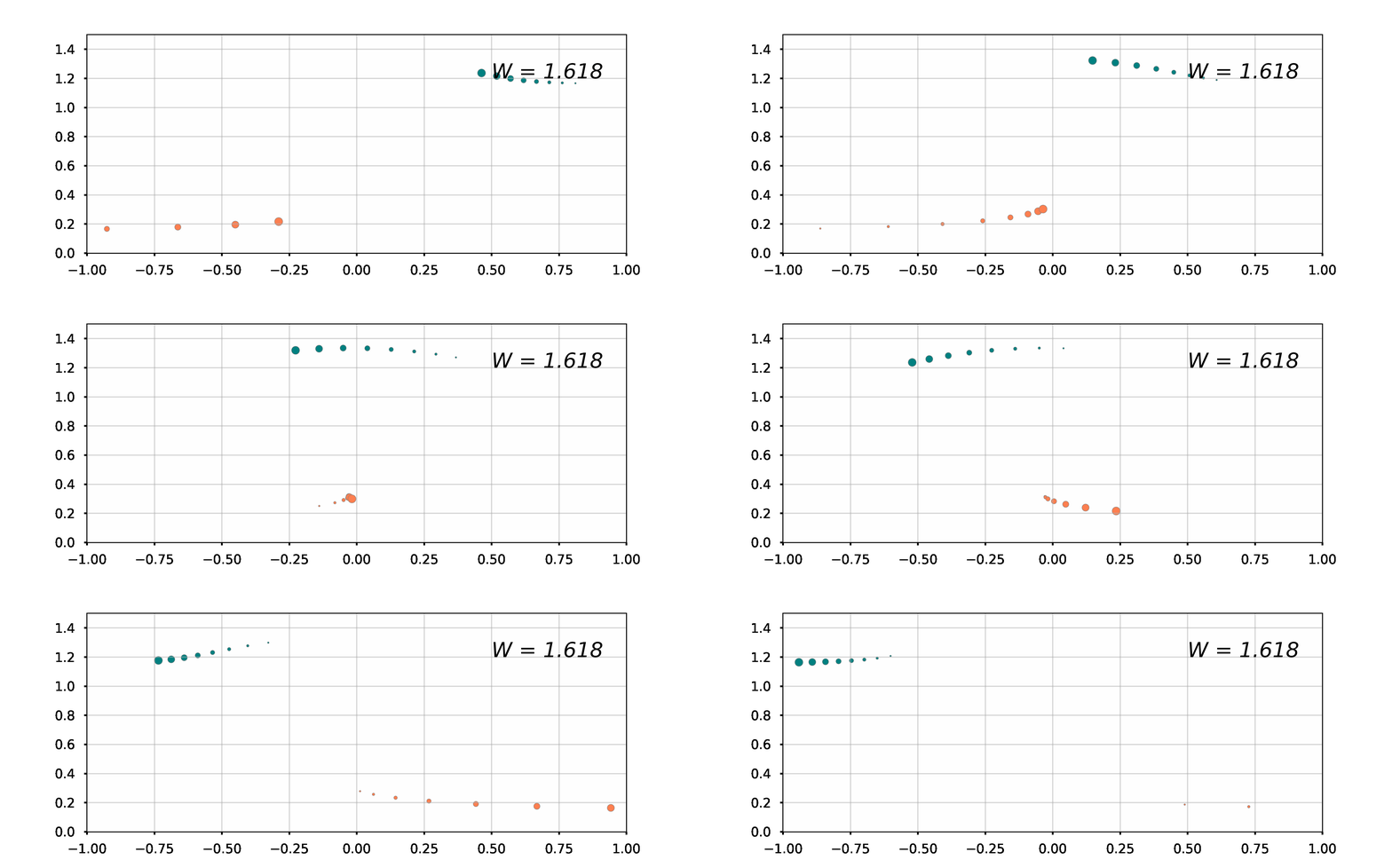
When two point vortices have same strength, we have the following four scenarios.
Vortex Dipole
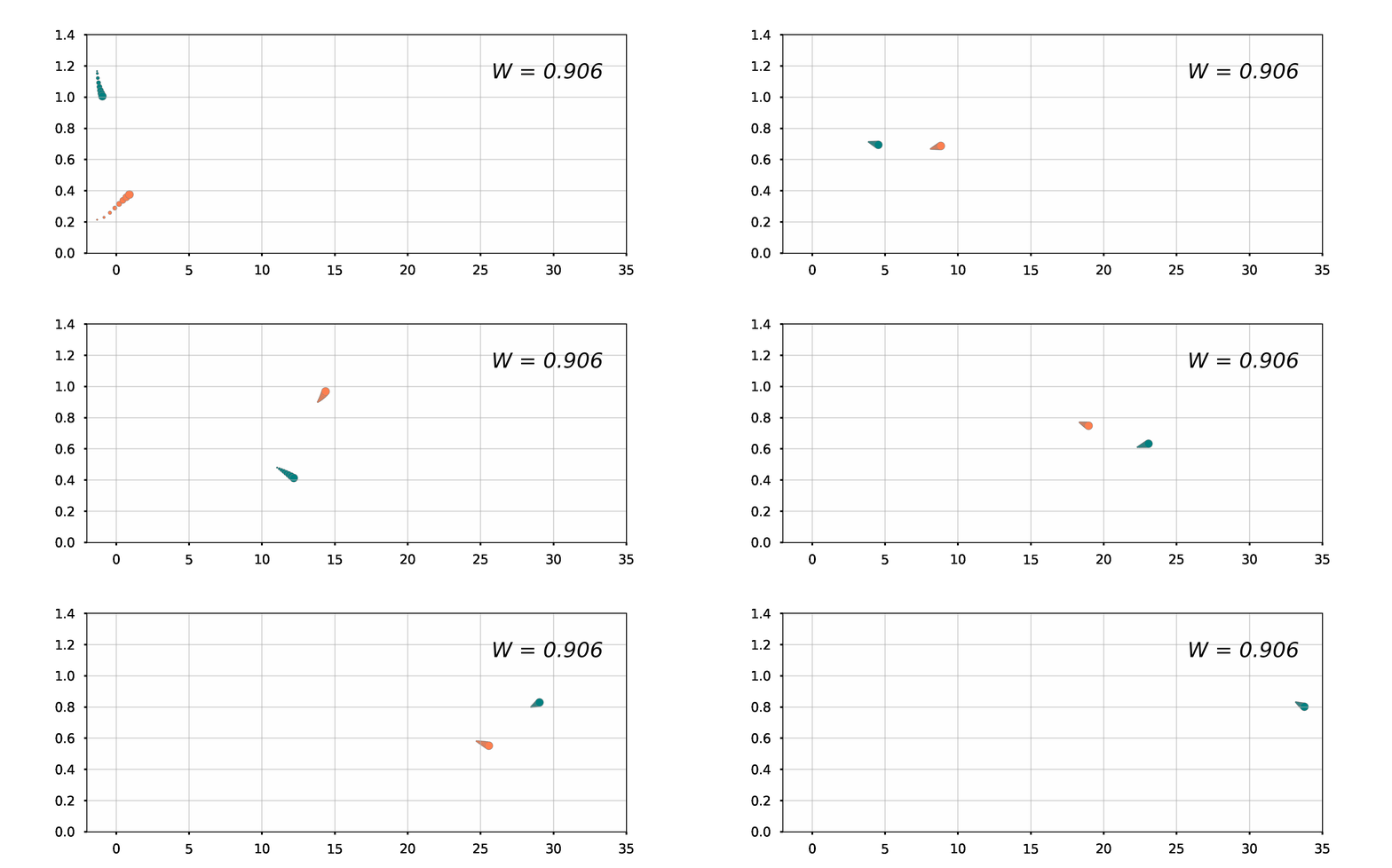
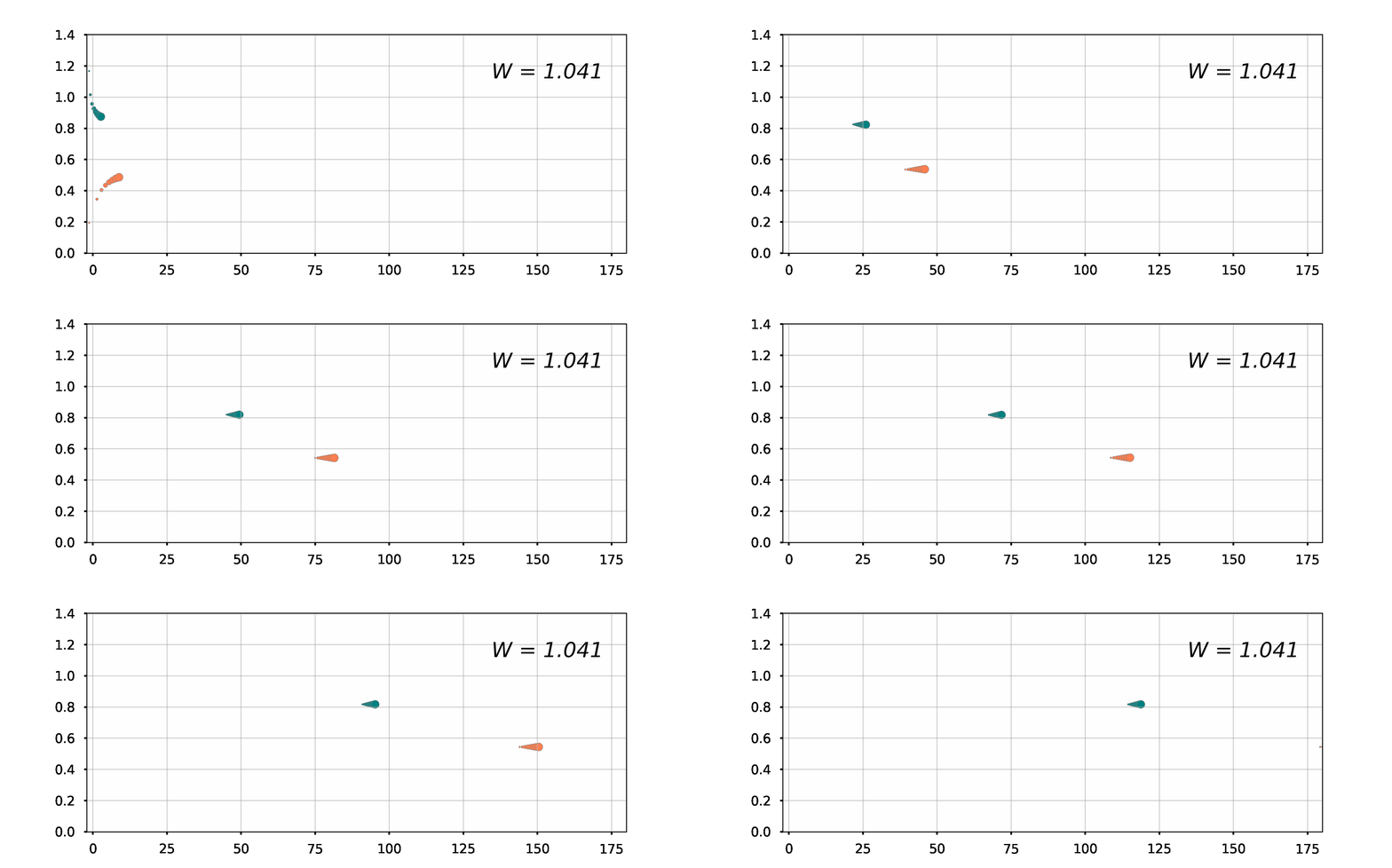
When two point vortices have opposite strength \(\Gamma_1=-\Gamma_2\), we have the following four scenarios.